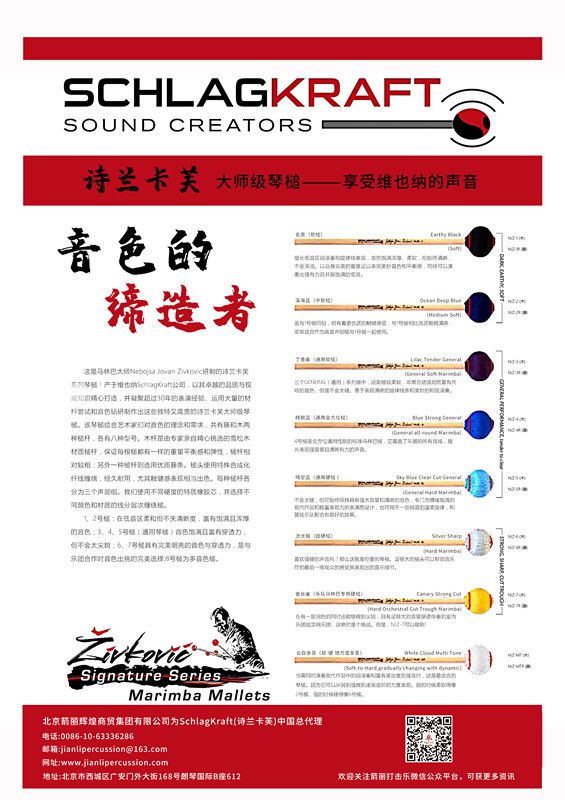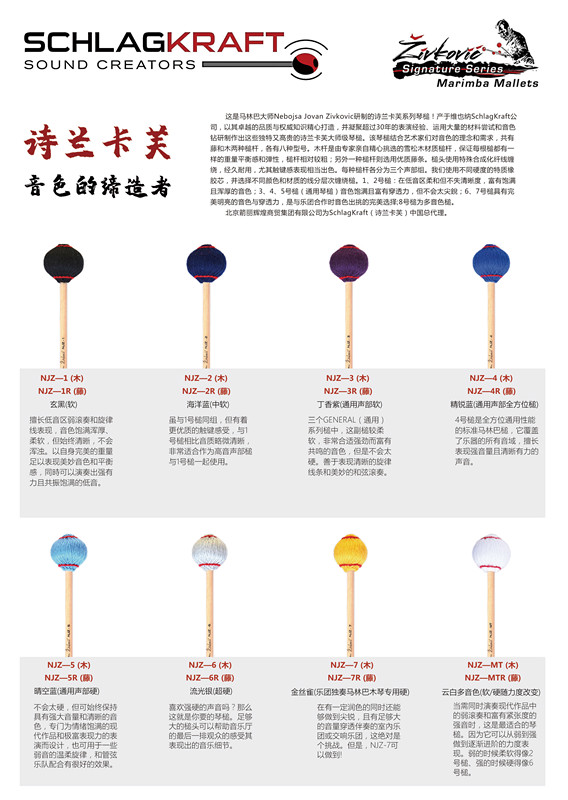
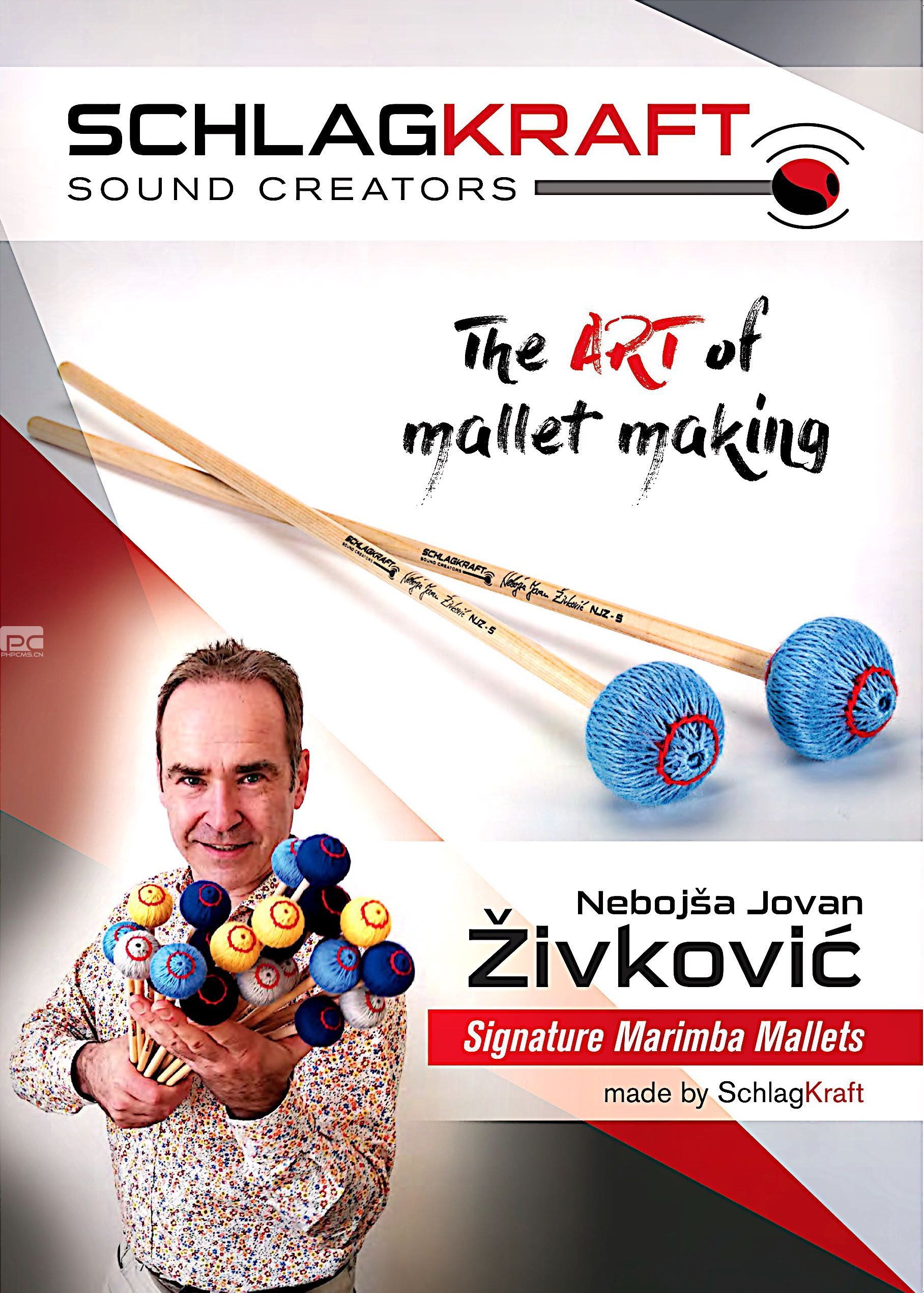
These are the SchlagKraft series mallets developed by marimba master Nebojsa Jovan Zivkovic! Produced by the Vienna-based SchlagKraft company, they are meticulously crafted with exceptional quality and authoritative expertise, drawing on more than 30 years of performance experience and extensive material experimentation and tonal research to create these unique and noble SchlagKraft artist-level mallets. Combining artists' ideas and needs regarding tone, the mallets come with two shaft types—rattan and wood—each in eight models. The wooden shafts are carefully hand-selected cedar, ensuring every mallet has the same weight balance and elasticity; the shafts are relatively thick. The other shaft type uses premium rattan. The heads are wrapped with a special synthetic fiber thread for durability, with especially outstanding touch response. Each shaft type is divided into three voice groups. We use specially made rubber cores of different hardness and wrap the heads in layers with threads of different colors and materials.
Mallets 1 and 2: soft yet clear in the low register, with a full and rich tone;
3. No. 3, 4, and 5 mallets (general-purpose mallets) have a full, penetrating tone but are not too piercing;
Mallets No. 6 and No. 7 have a perfectly bright tone and projection, making them the perfect choice for standing out when performing with an orchestra;
Mallet No. 8 is a multi-timbre mallet.
Beijing Jianli Huihuang Trading Group Co., Ltd. is the general agent in China for Austria's SchlagKraft.
Product Highlights
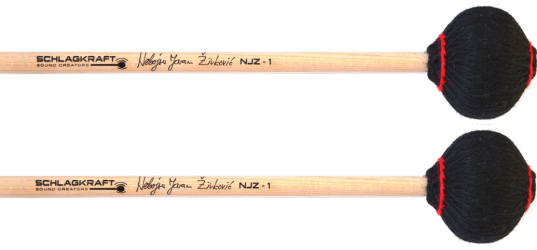
1. Deep black (soft)
Well suited to soft rolls in the low register and melodic lines; the tone is full, rich and soft, yet always clear and never muddy. Its ideal weight is enough to convey a beautiful tone and balance, while it can also produce powerful, resonant lows.
2. Ocean Blue (Medium-Soft)
Although it is in the same group as mallet No. 1, it offers a better key-touch feel; compared with mallet No. 1, its tone is slightly clearer, making it very suitable for use as a high-register mallet together with mallet No. 1.
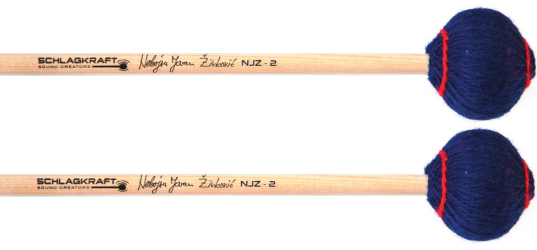
3. Lilac (general-purpose soft)
Among the three GENERAL series mallets, this pair is softer and very suitable for powerful, resonant tones, but not too hard. It is good at expressing clear melodic lines and beautiful chord rolls.
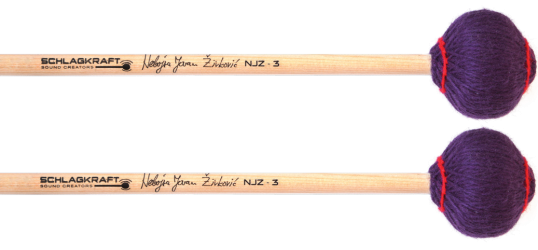
4. Elite Blue (All-Purpose Mallet for All Voices)
The No. 4 mallet is a standard all-around marimba mallet; it covers the instrument's entire range and excels at delivering a loud, clear, and powerful sound.
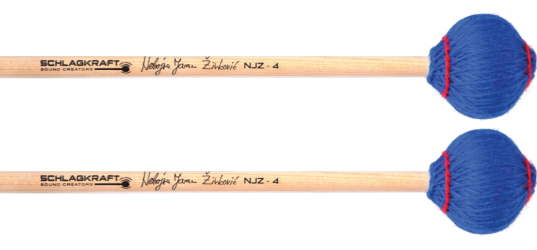
5. Sky Blue (all-purpose, hard)
Not too hard, yet able to consistently maintain a powerful volume and clear tone; designed specifically for emotionally rich modern works and highly expressive performances. It can also be used for gentle, soft passages at low dynamics and works very well with an orchestra.
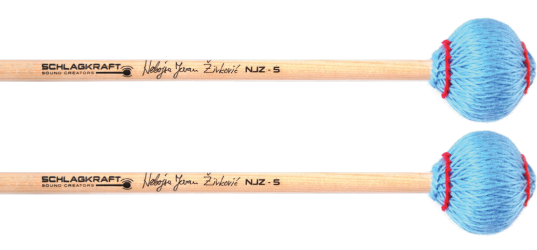
6. Flowing Silver (Super Hard)
Do you like a powerful sound? Then these are the mallets you want. A sufficiently large head helps the audience in the last row of the concert hall feel the musical details they convey.
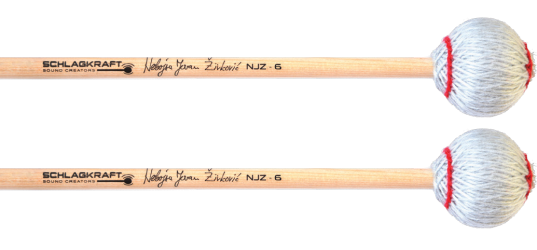
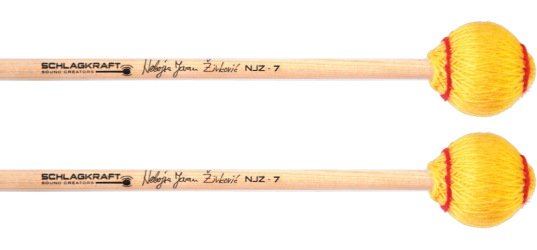
7. Canary (dedicated hard case for orchestra solo marimba and xylophone)
It is an absolute challenge to be polished while still sharp, with enough volume to cut through an accompanying chamber or symphony orchestra. But the NJZ-7 can do it!
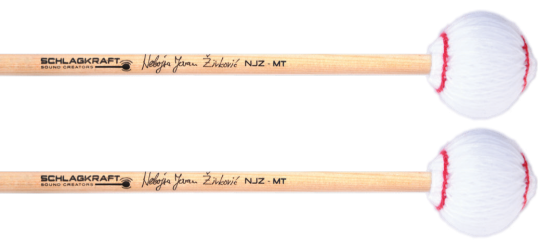
8. Cloud White, multi-timbre (soft/hard varies with playing strength)
This is the most suitable mallet when a modern work requires both soft rolls and tense accents. It can achieve a gradual progression in dynamics from soft to strong: soft as a No. 2 mallet at low volume, hard as a No. 6 mallet at high volume.
https://v.qq.com/x/page/w0976y0u0bw.html
The video linked here shows Ms. Zhang Jingli, associate professor of percussion at the Central Conservatory of Music, performing the marimba solo 'Sight' with SchlagKraft master-level marimba mallets. This work was adapted and created on the suggestion of Mr. Jin Jiguang, president of the China Percussion Association; its melody is drawn from the original dance drama Confucius by the China Opera and Dance Drama Theater, originally titled 'Cai Wei.' It was later adapted by Zhang Jingli into the marimba solo 'Sight,' in the hope of expanding Chinese musical elements within the Western percussion field and promoting traditional Chinese culture. The piece was created during this special period, with longing for loved ones and prayers for peace. Sight—a heartfelt tribute to the resilience of the Chinese people, a tribute to the dedication of medical workers, and pride in the prosperity of our great motherland.
'Gazing Afar' comes from 'Cai Wei' in the 'Minor Odes' section of the Book of Songs.
'Gazing Afar' means wish, hope, and longing.
Click and long-press the image below to save the high-resolution version